Galerie Peter Herrmann |
- | Ancient Art from Africa |
||
 |
 |
 |
||
 |
 |
|---|
| Thermoluminescence - Expertise | Abstract Leopard |
|
Bini, Nigeria |
| Edited in the net since October 2026 |
|
|---|
| Description |
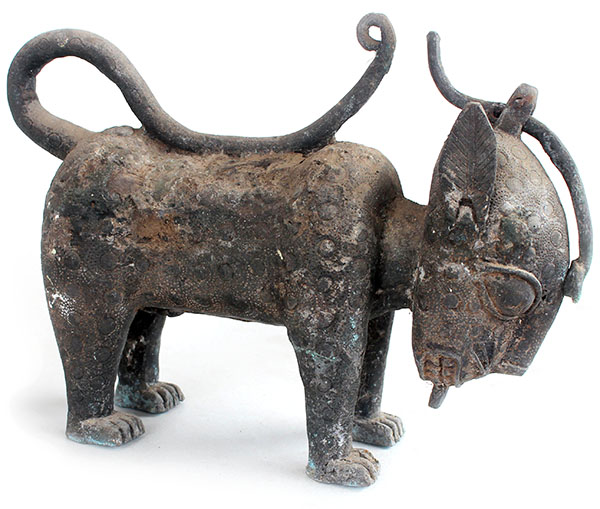
This bronze object is a curiosity in several respects. A clasp, such as is usually found on ritual vessels, appears to serve no practical purpose. Whilst it can be opened and closed for filling, there is no drain hole to be found anywhere. One can therefore fill the lower half of the head, but with what and for what purpose remains a mystery. The clasp has broken off at the hinge. The second striking feature is the design itself, which is somewhat reminiscent of a contemporary comic. An oversized head, a tail that is far too long, the tongue strangely sticking out, a very long penis with thick testicles, and a somewhat misshapen, stiff body. The only stylistically ‘authentic’ element is the traditional ornamentation of the fur. Judging by its weight, the body is completely filled with a clay casting core, which is unusual both functionally – as a vessel – and from a craftsmanship perspective. To prevent corrosion, the clay core is normally removed entirely so that it cannot absorb moisture. Initially, therefore, there were several reasons to assume that this was a recent object, crafted with a lack of technical refinement. On the other hand, the exaggerated proportions seemed to point to something mythological, such as a legend, and the patina, with its small efflorescences, appeared old and natural, not artificially treated. At just under 400 years old, and due to its distinctive features, this object is of great interest from an art-historical perspective. Because the content and concepts of truth in oral traditions constantly vary, deciphering it is likely to take a very long time and will always be accompanied by conjecture. |
|
|---|
|
