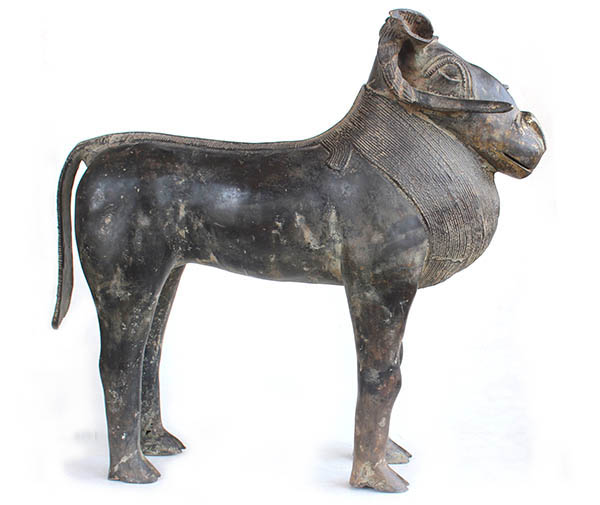
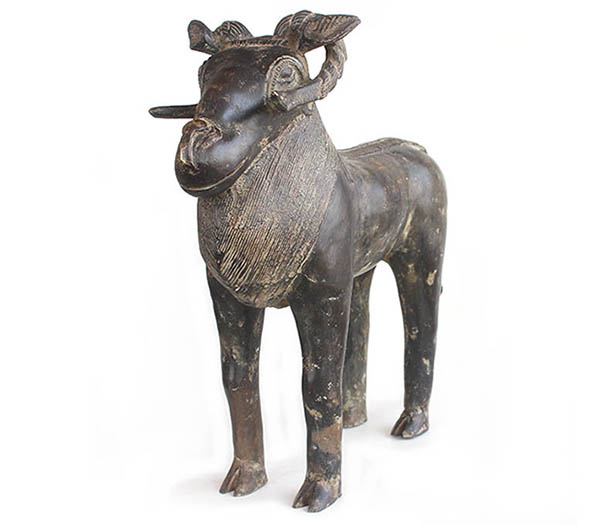
A very similar ram is housed in the British Museum in London. However, the London object is an aquamanile – a water vessel. Bronze objects, such as rams and leopards, were often used as water vessels and for ceremonial ablutions. Although this ram is very similar to the London specimen, it lacks the openings typical of an aquamanile at the head and nostrils. This object was probably created as a symbol of royal power for a king’s altar.
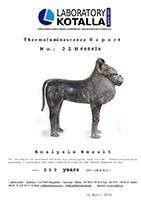
In Benin, the ram symbolises masculinity as well as perseverance, and was traditionally sacrificed during the Ague ceremony. Oba Esigie (-1550) developed this ceremony into a major festival. The naturalistic depiction, devoid of excessive symbolism, suggests that the ram is of great age, as determined by TL analysis.
There are slight signs of wear on the legs, caused by the patina. Otherwise, the sculpture is in very good condition. The casting is flawlessly executed. Its condition suggests it has been in the family and has been well looked after.
Cp.:
W./ B. Forman, Philip Dark: Die Kunst von Benin, Prag 1960, S. 58/ 59.
Barbara Plankensteiner (Hg.): Benin. Könige und Rituale. Höfische Kunst aus Nigeria, Wien 2007, S. 433. |