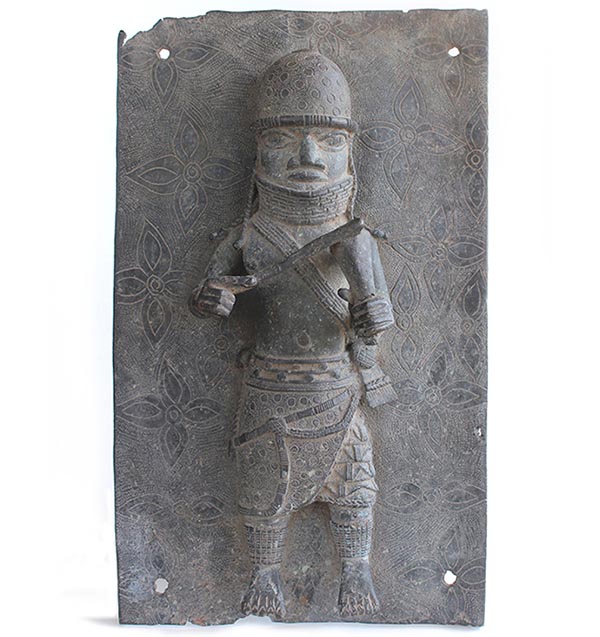
The motif of a man of high social standing ringing a bell is in good condition and undamaged. The bronze relief plaque shows only slight damage to the upper and lower edges.
As described in detail in Peter Herrmann’s 2008 article ‘Age Dating’, (fr), ethnologists – today almost exclusively female – have no conclusive criteria for dating objects, other than to rely on old, arbitrary estimates, which they then apply from one object to another. Whilst before the year 2000 the metal analyses largely corresponded with the thermoluminescence analyses, a single professor, using completely flawed premises, managed to sow so much discord that scientific dating methods are now entirely disregarded on the grounds that they are ‘not scientifically proven’.
Figures such as those depicted in the relief are particularly important for art-historical analysis due to their accessories. Whilst elements such as jewellery are sometimes retained over centuries, fabric decorations are changed seasonally.
A hat integrated into the helmet, a ruff made of red coral, a sword scabbard worn over the shoulder on a strap, and greaves suggest a hierarchical arrangement. It is striking that these warriors do not wear shoes. The fabric wrapped around the hips and thighs is highly revealing, whilst the upper body is bare. Held in place by an unusual belt, the skirt appears to consist of two layers with different designs
In addition to its aesthetically striking appearance, this plaque offers many clues for historical analysis. As contemporary anthropology shies away from maintaining contacts with traders and collectors – as was once customary in research under the toxic patriarchy – such assessments are now lost. German state-sponsored initiatives on questionable collaborations with Nigeria work solely on the basis of museum collections. |