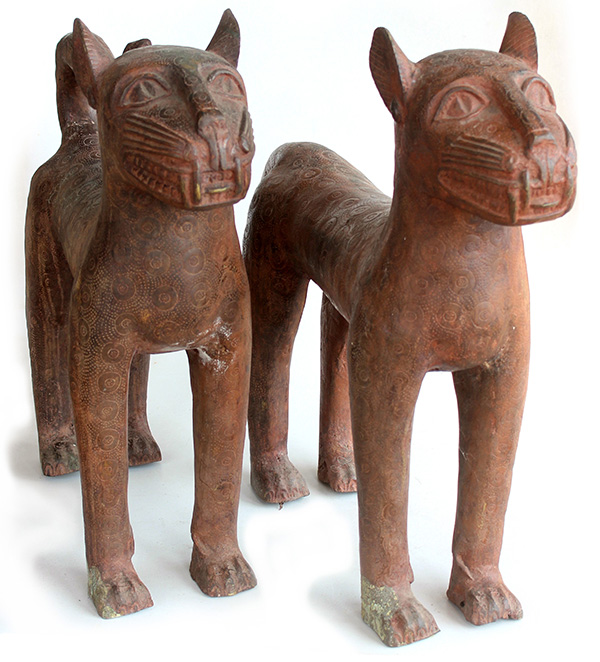
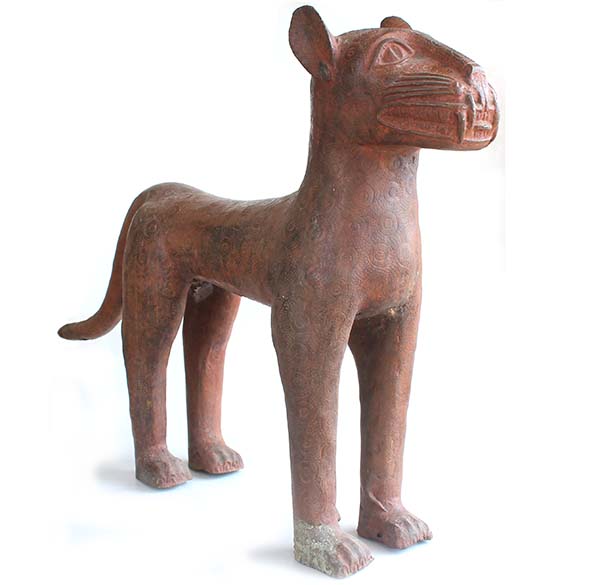
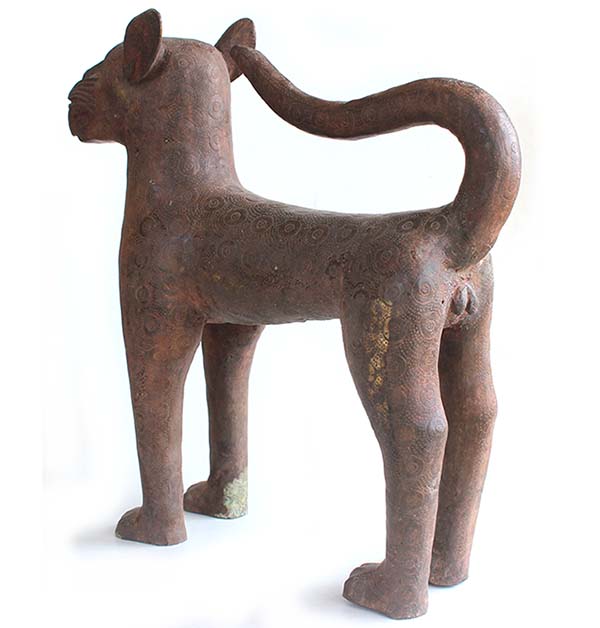
Although this pair of leopards is not particularly old, it can be considered authentic because it was produced for local use in a chief's palace and not for the tourist market. This view is difficult to classify from an art historical perspective, especially in the case of Benin bronzes, where some motifs have been repeated for over 500 years. For the Beninese, a piece is authentic regardless of its age. The European art market and ethnology there have drawn a line at around 1920. Anything before that is old, anything after that is handicraft and therefore of lesser value because it was no longer produced for indigenous needs but for an international market.
This makes a certain sense in terms of classification, but cannot be applied uniformly to everything, which is why this pair is shown and offered in the company of old, historical objects.
This pair has an unusually reddish finish and a beautifully aged patina. The quality of the lost wax casting is very high. There are chalky efflorescences on the feet, which will be carefully restored at some point. Very impressive overall appearance.
It comes from the same palace as the pair on the next page. |